Maternal Devices

Year
2026
Client
Central Saint Martins
Focus
Speculative Design
Challenging Heteronormative, Western Notions of Motherhood and Nourishment through Transdisciplinary Speculative Designs
Background and Research Territory
The current project examines how assistive milk pumping technologies actively construct and enforce specific notions of motherhood, femininity, and nourishment. Following the critical framework established by Fisher in Designing Motherhood (Fisher, 2021), the initial research phase identified a significant problem within Western approaches to breastfeeding. Contemporary device design heavily prioritises time efficiency, production yield, and visual discretion, which inadvertently contributes to widespread psychological, social, and musculoskeletal challenges for users. Bassin et al. argue in Representations of Motherhood that such functional imperatives often reinforce rigid, restrictive ideals of maternity (Bassin et al., 1994). To ground this theoretical critique in lived experience, the research methodology involved collecting qualitative attitudes from nursing mothers regarding their assistive technologies and daily routines.
Information Architecture and Data Sovereignty
The user discourse revealed a profound tension between the desire for personal pattern recognition and deep reservations about data privacy. Mothers expressed significant interest in understanding how daily stressors affect their bodily responses and subsequent milk production. However, they were highly sceptical of artificial intelligence involvement, third party data sharing, and subscription models that could trap them financially over time. This hesitation highlights the overwhelming mental load required to manage biological data on a daily basis. Drawing on Wark and A Hacker Manifesto (Wark, 2004), the project critiques the commodification of highly sensitive maternal data. The speculative response subverts these conventional data systems, proposing permacomputing architectures that prioritise user autonomy, ensure data security, and reject the extractive practices common in contemporary smart devices.
Speculative Design through the Abject
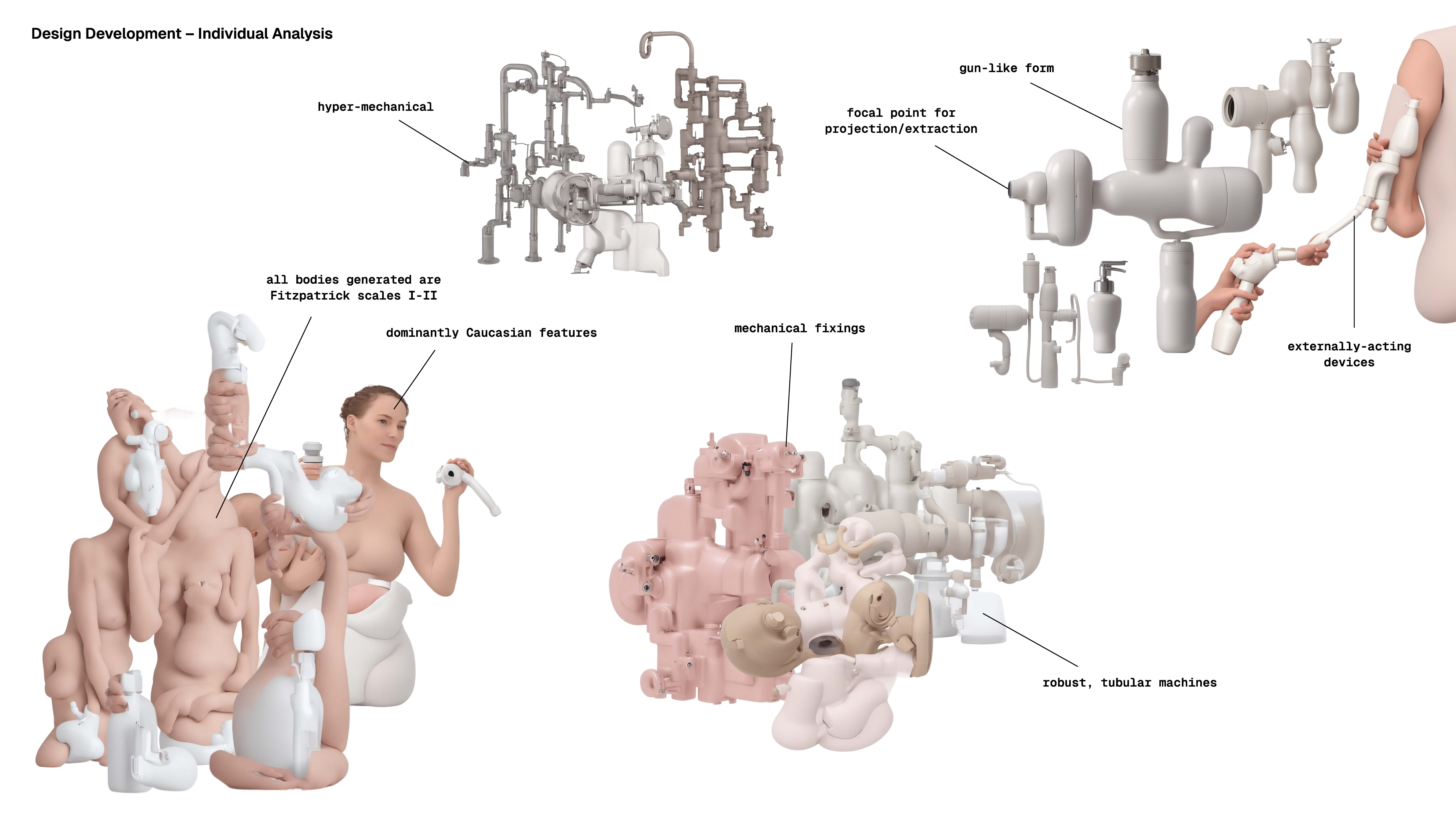
Moving beyond highly polished marketable products, the project embraces speculative physical expression to challenge prevailing cultural narratives. The methodology heavily references Kristeva and her seminal 1980 text Powers of Horror (Kristeva, 1980). By engaging with the concept of the abject, the design process explores themes that threaten our sense of cleanliness and propriety, specifically focusing on bodily fluids, tissue structures, and maternal physical realities. Through life casting an evolving vessel and creating speculative sketches, the physical prototypes integrate biological motifs like areolar connective tissue histology, Mongolian spots, and stretch mark patterns. This approach actively blurs the boundaries between maternal flesh and the machine, echoing the theoretical propositions Haraway established in A Cyborg Manifesto (Haraway, 1985). Furthermore, by incorporating visceral materials such as medical sutures, placenta references, and repurposed surgical curtains folded over eyelets, the work navigates the profound emotional ambivalence of maternal technology explored extensively in the works of Yurman (Yurman, 2018).
Pathways Forward: Divergence and Entangled Maternal Ecosystems
Moving forward, this project actively embraces the condition of convergence by exploring the deeply co-implicated nature of human and machine agency within the maternal sphere. While current objective-driven technologies often default to optimising toward predetermined outcomes, the next phase of this research acts as an engine of divergence. By introducing permacomputing principles to speculative maternal wearables, the work will destabilise the rigid boundaries between biological bodies and machine infrastructures. The research questions how we sense, move, and feel when our most intimate physiological states interact with computational systems. Instead of treating the nursing body as a site of data extraction, future development will test physical and digital frameworks where maternal realities and technologies undergo a continuous process of mutual reconstitution.
The broader value of this work lies in its capacity to reshape cultural and societal systems surrounding care and technological accountability. By building an open alphabet of maternal devices grounded in privacy and autonomy, this project provides a vital counter-narrative to commercial tech models that thrive on surveillance. It opens up spaces where categories of ownership are radically reimagined to protect vulnerable demographics, particularly women of colour and mothers within colonised contexts. Sharing this methodology across a wider network will enable other practitioners, technologists, and organisers to critically examine how we live with entanglement. Ultimately, this foundational research serves to seed new, transdisciplinary art ecosystems, demonstrating that advanced technologies can constructively support the complex, unquantifiable processes of human grief, growth, and repair.




Works Cited
Bassin, D., Honey, M., & Kaplan, M. M. (1994). Representations of Motherhood. Yale University Press.
Fisher, M. M. (2021). Designing Motherhood: Things That Make and Break Our Births. MIT Press.
Haraway, D. (1985). A Cyborg Manifesto: Science, Technology, and Socialist Feminism in the Late Twentieth Century. Socialist Review.
Kristeva, J. (1980). Powers of Horror: An Essay on Abjection. Columbia University Press.
Wark, M. (2004). A Hacker Manifesto. Harvard University Press.
Yurman, P. (2018). Emotional ambivalence in maternal technology. Central Saint Martins.